This post is part of my TaskHub series. In the previous post, I described how I move from a system specification to a verified Oracle implementation with Codex. Here I focus on how I structure one development task before handing it to Codex.
I will use Task 50 — Tasks / Subtasks API as a running example. It covers creating, updating, and soft-deleting tasks and subtasks, including hierarchy rules, ownership checks, and task status behavior.
Why I Give Codex a Structured Task
Implement task management. leaves too much open to interpretation. I want a bounded unit of work that defines the change, protects earlier decisions, and makes completion testable.
The structure below is what I currently use. It developed during the TaskHub lab. I do not present it as a universal or optimal format.
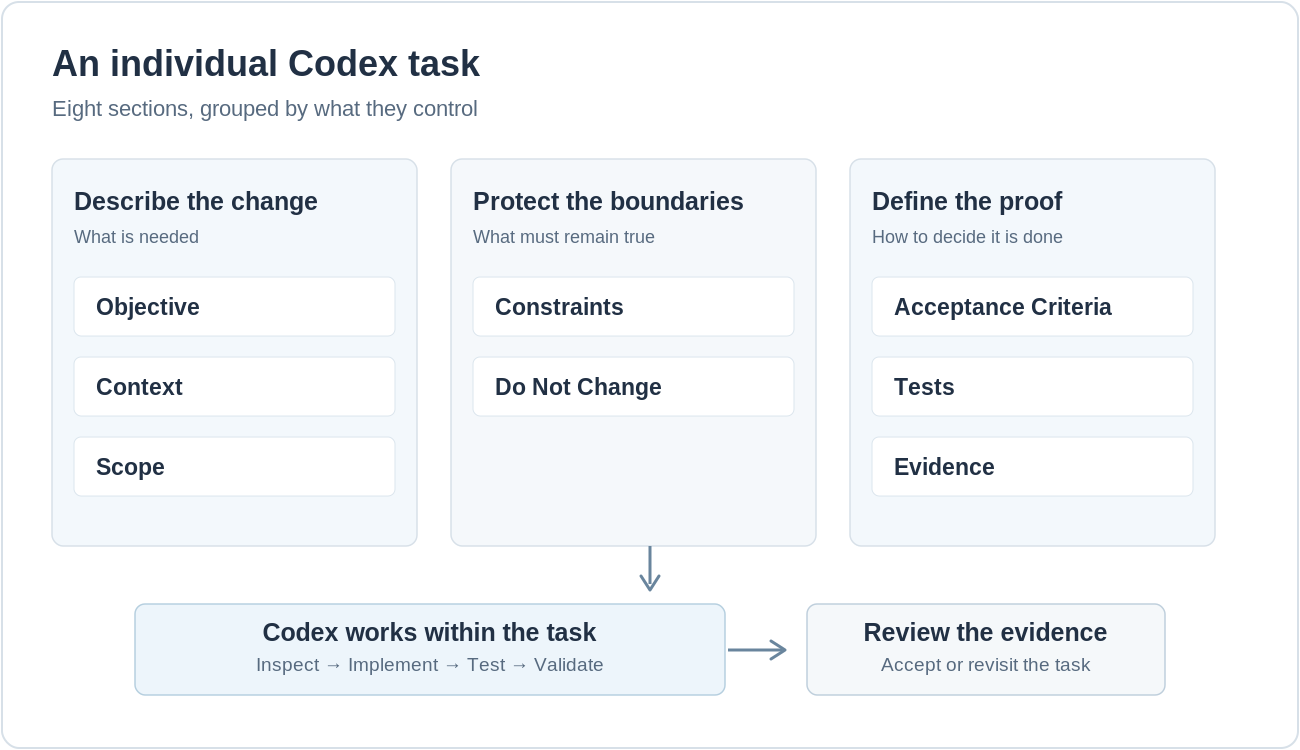
The Eight Sections of My Task
I usually divide each task into eight sections. Their size varies with the work involved.
Objective — What I Want to Achieve
The principle
The objective is one clear statement of the result I want. It provides direction without repeating the full specification.
Task 50 example
Implement task and subtask operations in the existing application API.
Context — What Already Exists
The principle
The task builds on earlier work. I identify the relevant components and decisions so Codex does not redesign something that is already in place.
Task 50 example
The task depends on established parts of TaskHub:
- The existing data model for tasks and lists.
- The application context and ownership checks.
- The read views and existing API conventions.
- The behavior already implemented and validated in previous tasks.
Scope — What Belongs to This Task
The principle
The scope lists the operations and behavior I want to change now. Related ideas do not automatically become part of the task.
Task 50 example
The relevant public operations are:
CREATE_TASK— create a task or subtask.UPDATE_TASK— update properties, state, or parent relationship.DELETE_TASK— soft-delete a task and its subtree.
Constraints — What Must Remain True
The principle
Constraints define rules that the implementation must satisfy. A function that appears to work is not acceptable if it breaks one of these rules.
Task 50 example
- Task hierarchy depth must not exceed three levels.
- Priority must be in the range
1..3. - Setting
DONEmust setCOMPLETED_AT; leavingDONEmust clear it. - Deleting a task must soft-delete its subtree.
- Ownership must be enforced without exposing another user’s data.
- The caller controls the transaction; the API must not commit on its behalf.
Acceptance Criteria — What Counts as Success
The principle
Acceptance Criteria state what must be true before I can consider the implementation successful. They are the target conditions, not the test output.
Task 50 example
- The required procedures exist and compile successfully.
- Valid task and subtask operations work as specified.
- Invalid operations are rejected correctly.
- Ownership and non-disclosure rules hold.
- Existing public APIs remain compatible and runtime grants stay restricted.
Tests — How I Check the Implementation
The principle
Tests are part of the task, not something I invent after the code has been written. I specify both allowed behavior and the failures the API must prevent.
Task 50 example
- Positive tests: create, update, re-parent, and soft-delete valid tasks.
- Negative tests: reject invalid priority values and excessive hierarchy depth.
- Security tests: verify ownership enforcement and non-disclosure.
- Regression tests: confirm earlier API behavior still works.
Do Not Change — What Codex Must Preserve
The principle
This section protects decisions already made. It is different from behavioral constraints: it defines changes the agent must not make while solving the current problem.
Task 50 example
- Do not redesign completed tasks or change established architecture without approval.
- Do not change existing public API contracts unless explicitly required.
- Do not create database users or use
SYSorSYSTEM. - Preserve the existing security model and restricted grants.
- Do not expand the implementation beyond Task 50.
Some of these rules are specific to my lab. They are not universal Oracle development rules.
Evidence — What I Want to Inspect
The principle
When Codex reports that a task is complete, I do not want to rely only on a statement that everything passed. I want to see what was actually checked and what the results were.
This is what I mean by Evidence: inspectable results that support the claim that a task was completed successfully.
The distinction matters:
- Acceptance Criteria define what must be true.
- Tests define how I will check it.
- Evidence records what was checked and what happened.
Evidence makes the result reviewable. It also helps me investigate failures or verify a previous checkpoint later. A PASS statement, without supporting results, is not enough.
Task 50 example
For Task 50, the evidence I would expect includes:
- Object-validity and compilation checks, including relevant
USER_ERRORSqueries. - Test output for
CREATE_TASK,UPDATE_TASK, andDELETE_TASK. - Negative-case output showing the expected rejection of invalid operations.
- Ownership and non-disclosure test results.
- Grant and metadata checks, together with an updated task status.
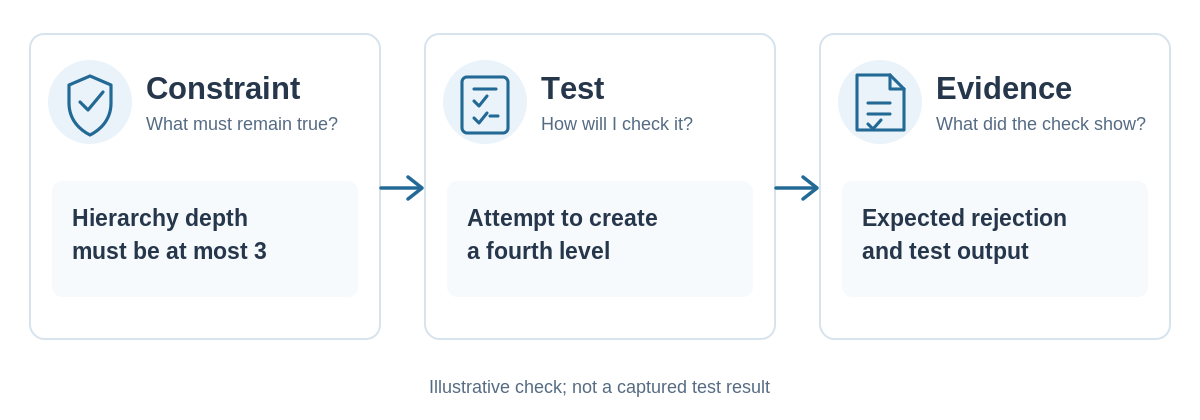
From Constraint to Evidence
A small example shows the relationship. The diagram describes an illustrative verification path, not a captured test log.
Definition of Done — When I Close the Task
For me, a task is not done when the source files exist. Three conditions must come together: the change is implemented, the required checks pass, and the evidence is available for review.
The Completion Check
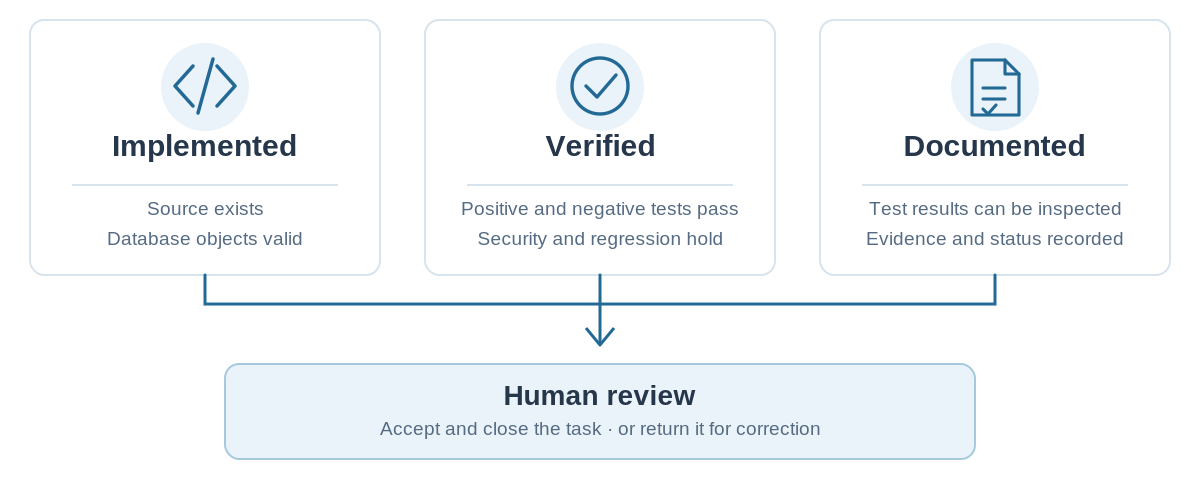
Codex can execute checks and collect results, but I decide whether the task is accepted. A failed check or unclear result means more work, not automatic closure.
This is a checkpoint for the defined task, not proof that the entire application is defect-free. The next post will focus on how I make Codex demonstrate that its Oracle changes worked.